
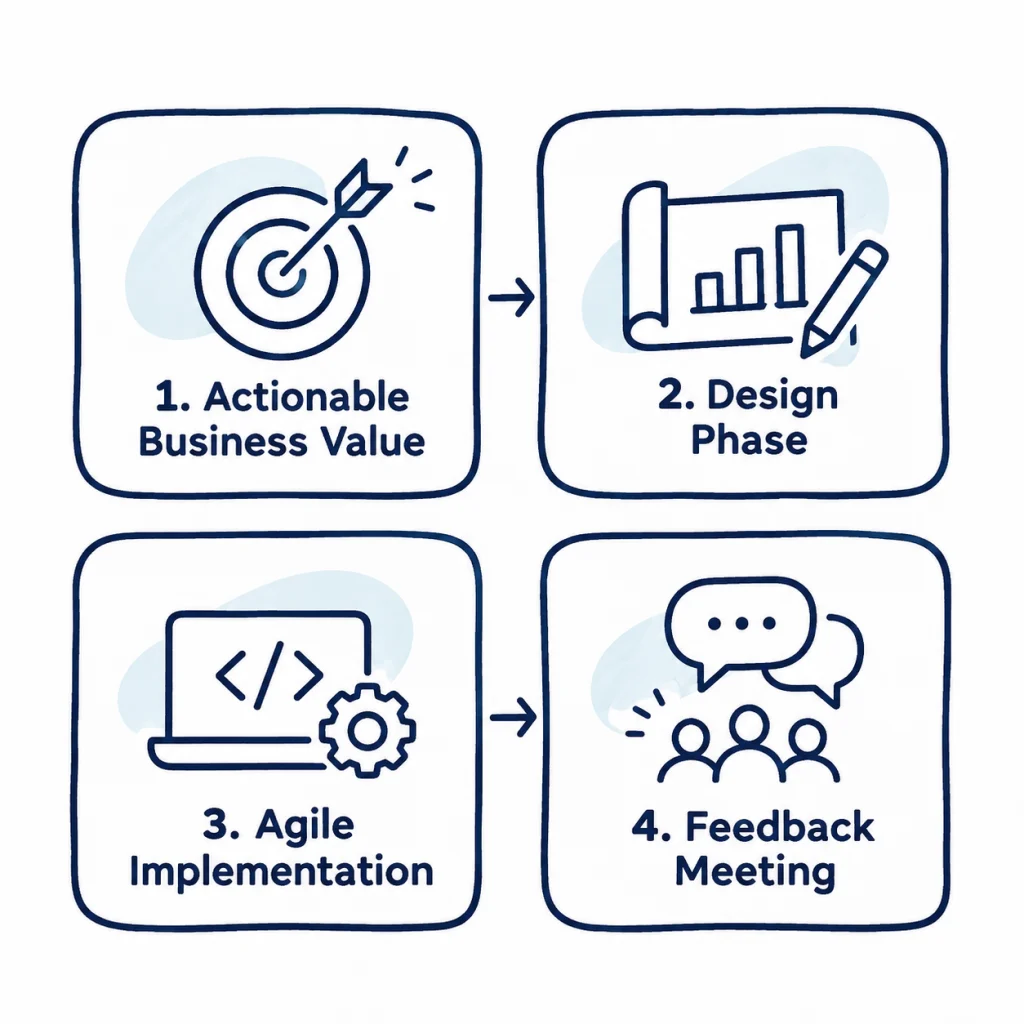
How can we ensure that our investments in data, analytics and AI translate into actual business value?
Whether the product is a data model, a dashboard, a predictive analytics solution or a generative AI agent, understanding how it creates value is a useful starting point. This can mean, for example, enabling better decisions, improving operational efficiency, automating tasks or enabling entirely new business capabilities. In this article, we take a closer look at a practical Data Product Value Delivery Process consisting of four steps:
- Actionable Business Value
- Design Phase
- Agile Implementation
- Feedback Meeting
The process is primarily intended for new data products and significant enhancements. For smaller improvements and bug fixes, regular sprint planning is often sufficient.
1. Actionable Business Value
Understanding the business need and implementation readiness
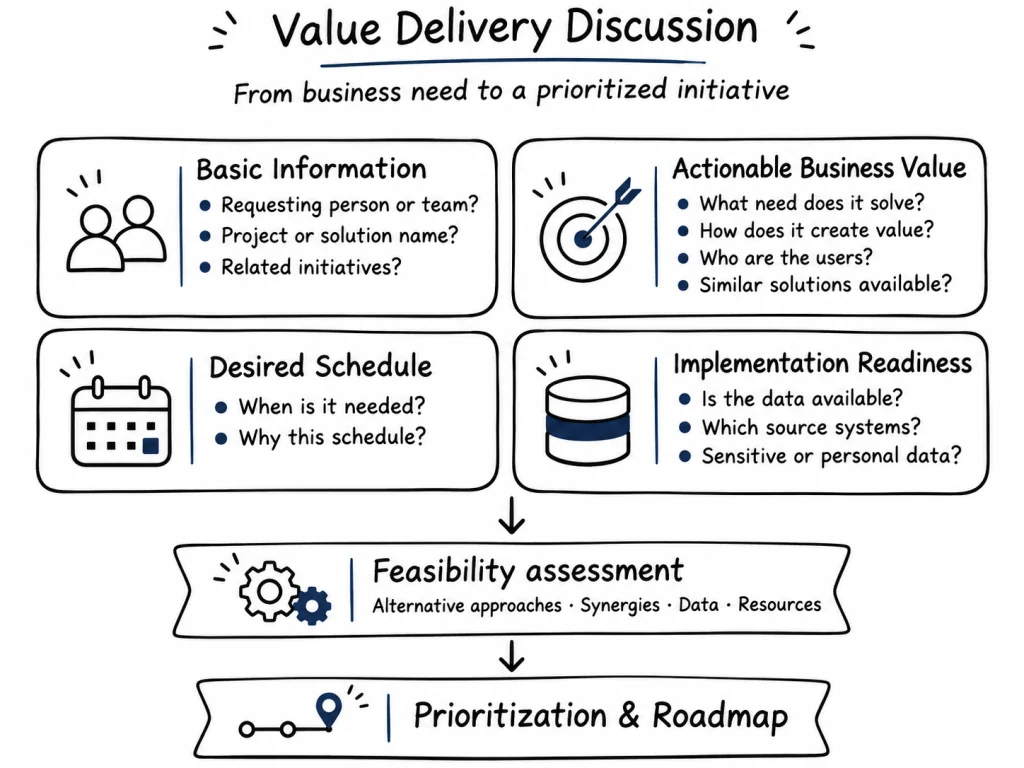
When a business stakeholder requests a new data product, it is often useful to start by exploring the business need and expected value rather than the technical implementation. While larger initiatives may require comprehensive business cases and formal investment proposals, most data product initiatives benefit from a more lightweight approach, particularly in the early stages when the right solution and scope are still being explored. At this stage, the objective is less about creating an exhaustive business case and more about asking the right questions to understand how to move forward.
A structured Value Delivery Discussion or request form covering the four areas illustrated below provides a practical starting point.
Feasibility assessment and prioritization
Based on this information, it makes sense for the data team to consider alternative approaches, opportunities to reuse existing solutions, synergies with other initiatives, data availability and resource requirements. The outcome provides a foundation for deciding whether and how to proceed, as well as for prioritization, resourcing, scheduling and roadmap planning. More detailed business case assessments can be carried out where the scale or complexity of the initiative justifies them.
2. Design Phase
A. Understanding user groups and their needs
Different user groups can have very different needs, even when working with the same underlying data. Four questions can provide a useful framework for defining use cases:
- WHO – Who will use the data product?
- USAGE TYPE – How and for what purpose will it be used?
- HOW OFTEN – How frequently will it be used?
- WHAT – What information or capabilities are needed?
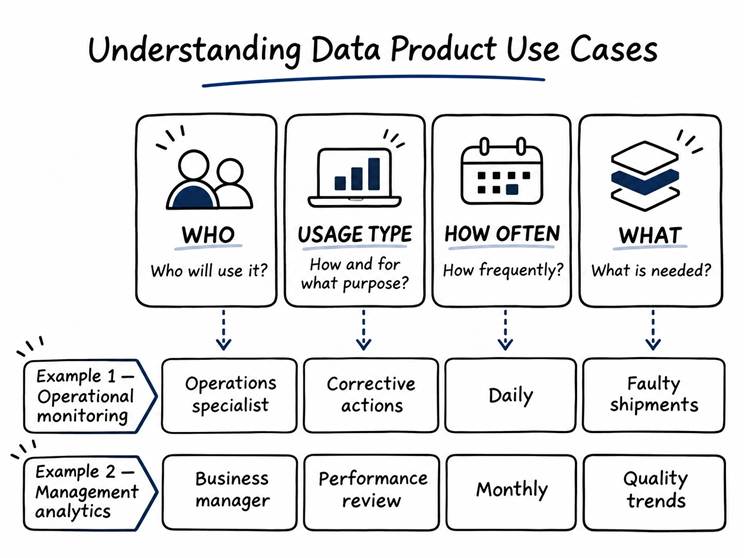
For example, an operations specialist might need to identify problematic shipments daily to take corrective action, while a manager might need to understand monthly trends in delivery quality. The WHAT helps shape shared data and business logic. WHO and USAGE TYPE can inform the user experience and delivery channels, while HOW OFTEN has implications for data freshness and processing requirements.
A shared data model can support operational applications, management dashboards, automated workflows and AI agents. Direct conversations with users and a good understanding of the underlying business processes can bring valuable context to the design.
B. Defining KPIs, measures and business logic
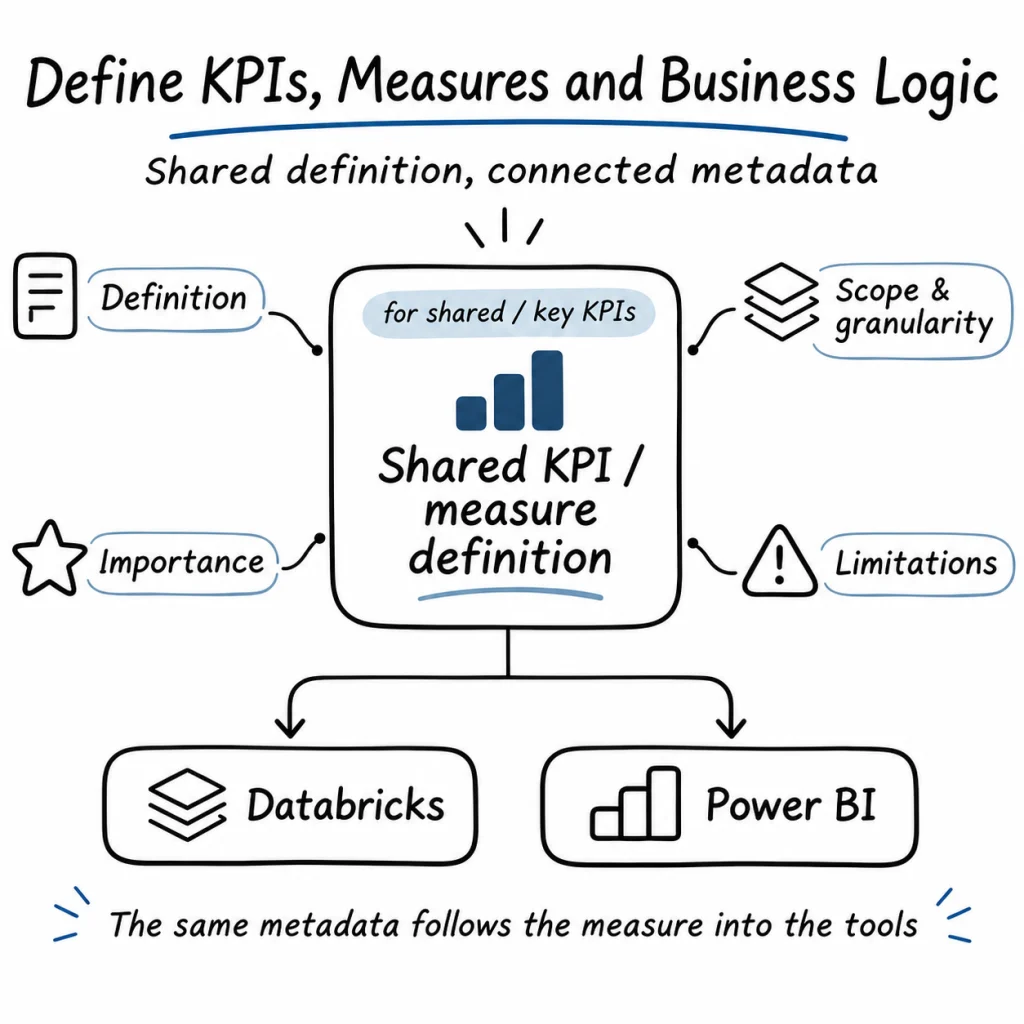
When defining a new business measure, it is worth exploring whether a suitable definition already exists. For widely used metrics such as sales, margin, customer satisfaction and quality, shared, centrally maintained definitions can help maintain consistency across data products. For key measures, having an identified business owner and consistent metadata can be valuable. Useful metadata includes:
- Business definition and intended use
- Source of the shared definition
- Scope and granularity
- Importance classification, e.g. primary KPI, supporting measure or technical measure
- Known limitations
Importance classification is particularly valuable for GenAI, helping agents distinguish core business measures from supporting or technical calculations. Descriptions written from a business user’s perspective can be more useful than explanations of technical calculation logic alone.
Shared definitions and documentation where consumed
A central KPI handbook or metrics repository can be valuable for shared business metrics, but not every measure needs to be maintained centrally. For example, report-specific measures can be defined and documented directly within the data or semantic model. An organization may have hundreds of measures in active use, although some are considerably more important than others.
Regardless of where a measure is defined, it makes sense to follow consistent documentation principles. Integrating or directly linking business definitions, scope, granularity, importance classifications and known limitations to the metadata of the actual measure helps keep this context close to the data. This makes documentation more accessible to both business users and GenAI agents, provided the consuming solutions have access to the relevant metadata.
C. Defining the scope of the first version
A well-defined minimum viable product (MVP) with a realistic delivery schedule is often more valuable than a perfect product plan with no clear delivery date. When considering the scope of the first version, a few questions can be helpful:
- Does it solve a concrete and lasting need?
- Can we narrow down the scope?
- Is it necessary for the first version?
D. Reviewing the data model architecture
Once the use cases, business definitions and initial scope are understood, a conceptual drawing of the proposed data architecture can be a useful starting point. Such a drawing can illustrate the main entities, relationships, data sources and relevant loading or data freshness requirements. It is also a good opportunity to consider which existing data products could be reused and where new modelling might be needed. For example, an operational events model could reuse existing customer and product dimensions while introducing a new incrementally loaded event fact table.
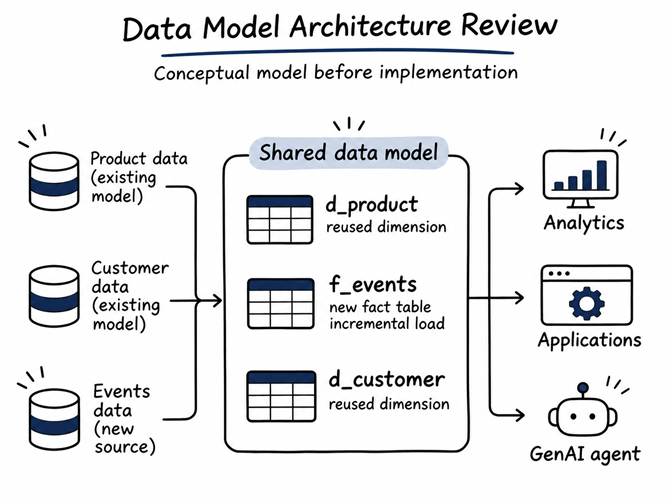
A review with another data professional can provide a useful second perspective before major implementation decisions are made. The value of an early review lies in identifying potential problems, improving reusability and reducing unnecessary technical debt.
3. Agile Implementation
Development in collaboration with the business
Regular communication with business stakeholders and users can be valuable throughout implementation – for example, every two days or once a week, depending on the project. Breaking larger development activities into manageable tasks and demonstrating working increments can help keep the discussion focused on a recurring question: Does this help solve the need we identified? Early feedback makes it easier to find practical compromises and adjust the solution.
Validation before going into production
Testing and approval by business stakeholders before a production release can help establish whether the solution meets the intended need. Depending on the product, validation can include data accuracy, usability, business logic, AI-generated answer quality and the reliability of automated workflows. A technically functioning product is not necessarily a business-ready product.
4. Feedback Meeting
Evaluating the actual value delivered
A feedback meeting with business stakeholders and active users approximately one to two months after the production release can provide useful insights into how the product is working in practice. The discussion could cover questions such as:
- What works well?
- Does the solution deliver the intended business value?
- Could changes to the functionality or user experience improve value delivery?
- What could we improve in our development process and collaboration?
Where available, product usage metrics and a comparison of actual outcomes with the original business objectives can add context to the feedback.
Systematic feedback collection as a performance objective
One approach worth considering is making systematic business feedback collection an annual team or individual performance objective, with measurable targets for completed feedback discussions. This can encourage data professionals to actively seek feedback, understand the impact of their work and learn from business stakeholders. In my experience, this approach has been well received in organizations where it has been implemented and has coincided with improvements in employee engagement survey results, including Peakon scores. Feedback can benefit not only the data product but also the people developing it, helping them see the impact and purpose of their work.
The goal is not to deliver more data products. It is to deliver more value through data products.